
Iranian forces are waiting for US troops to arrive to ‘set them on fire’, speaker says
We have some more comments from the Iranian parliament speaker, Mohammad Bagher Ghalibaf, who has published a message marking 30 days since the start of the US-Israeli war on Iran (see post at 10.10 for details).
Iranian forces “are waiting for the arrival of American troops on the ground to set them on fire and punish their regional partners forever,†Ghalibaf said.
He added: “Our firing continues. Our missiles are in place. Our determination and faith have increased.â€
The comments came as the Saudi Arabian foreign minister is set to join his Egyptian, Pakistani and Turkish counterparts in Islamabad later today for talks aimed at reducing regional tensions.
Despite such diplomatic efforts, the Pentagon is preparing for weeks of “ground operations†in Iran, US officials have told the Washington Post, as thousands of US soldiers and marines arrive in the Middle East.
Key events
Please turn on JavaScript to use this feature
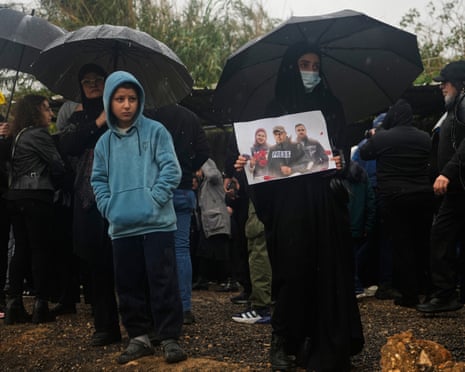
The funeral has taken place in Lebanon for three journalists killed by an Israeli strike on Saturday, an attack which Beirut called a “blatant crimeâ€.
Ali Shoeib, a veteran correspondent for Hezbollah's Al Manar TV, Fatima Ftouni of the pro-Hezbollah Al Mayadeen channel and her brother, cameraman Mohammad Ftouni, were all killed when their vehicle was hit in Jezzine in southern Lebanon.
Israel's military in a statement alleged that Shoeib “operated within the Hezbollah terrorist organisation under the guise of a journalist for the Al Manar networkâ€, without providing evidence.
It did not comment on the deaths of Ftouni and her brother.
Two India-bound liquefied petroleum gas tankers carrying about 94,000 metric tons of the cooking gas have safely passed through the strait of Hormuz and are heading towards India, its government has said.
The carriers BW Tyr and BW Elm are expected to arrive in Mumbai on 31 March and New Mangalore on 1 April respectively, the petroleum ministry said in a statement.
The war has all but halted shipping through the strait, but Iran has said “non-hostile vessels†may use the waterway if they coordinate with Iranian authorities.
Reuters reports that the ships are the latest Indian-flagged vessels to make it through. Four LPG tankers have already completed the crossing, while three more are still in the western section of the strait, LSEG ship tracking data showed on Friday.
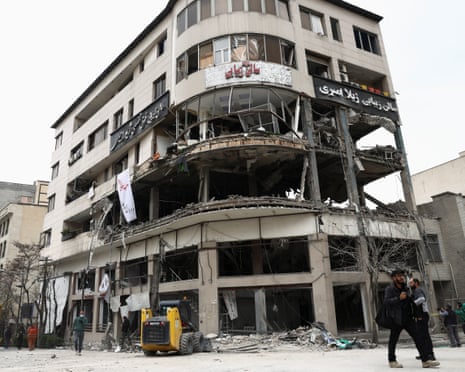
Qatari news channel Al Araby has condemned the strike on its Tehran office building (see earlier post)
The channel said in a statement to AFP that it “condemns this attack on a civilian commercial building and affirms that endangering journalists or considering them targets runs counter to international lawâ€.
It added that, according to the Iranian Red Crescent 10 people, had been injured in the Sunday morning strike.
In a post on X, Anwar Gargash, the diplomatic adviser to the UAE's president, wrote:
double quotation mark Any political solution addressing the Iranian aggression against the Arab Gulf states must include clear guarantees to prevent future violations, uphold the principle of non-aggression, and mandate Iranian reparations for targeting civilian and vital facilities as well as civilians.Iran deceived its neighbors about its intentions before the war and revealed premeditated aggression despite their sincere efforts to avoid it, making these two paths essential in confronting a regime that has become the primary threat to the security of the Arab Gulf.
Here are some lines from an interesting analysis piece by my colleague Saeed Shah about Pakistan's mediation role in the war:
double quotation mark Pakistan's diplomatic efforts intensified on Saturday, with the country's prime minister, Shehbaz Sharif, calling the Iranian president, Masoud Pezeshkian, and the announcement the foreign ministers of Turkey, Egypt, Saudi Arabia and Pakistan will hold talks in Islamabad on Sunday and Monday about how to end the war.These four countries are emerging as a new alignment within the Muslim world, packing three of the biggest armies in the region, nuclear weapons and Saudi Arabia's financial heft. But officials from Saudi Arabia, which has been repeatedly hit by Iran, have privately said that they want the bombardment to continue.
Islamabad expects any talks to be indirect, with Pakistani officials shuttling between the US and Iranian delegations in different rooms. Tehran refuses to sit down face-to-face with US officials.
Pakistan is nuclear-armed with a large army that could secure a venue for talks, while its air force could provide Iranian officials with an escort to fly in.
Iran says Washington is again trying to deceive, having twice bombed them over the past year in the midst of talks. A buildup of US troops in the region suggests peace talks may not be the US's plan.
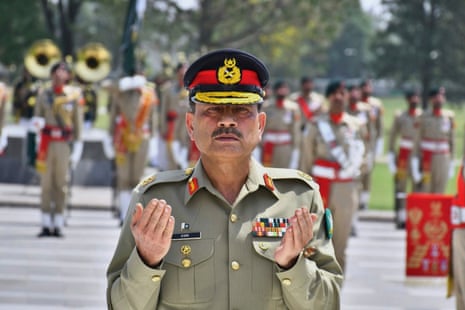
Al Jazeera is reporting that Saudi Arabia's foreign minister has arrived in Islamabad, Pakistan's capital, for talks with his counterparts from Pakistan, Egypt and Turkey.
The ministers will hold “in-depth discussions on a range of issues, ​including efforts to de-escalate tensions in the region†during the two-day talks, ​Pakistan's foreign ministry said yesterday.
The internet blackout in Iran has entered its 30th day, according to internet monitoring group NetBlocks. It said in a post:
double quotation mark Iran's internet blackout has now entered day 30 as the nationwide censorship measure continues into its fifth week after 696 hours.Metrics show that connectivity to the outside world remains at just 1% of ordinary levels.
Those without access to Starlink or alternative ways to communicate – which are often expensive – are cut off, not only from the outside world but the blackout also severely curtails Iranian's ability to communicate with each other, making mobilisation, for example, much more difficult.
Iranian forces are waiting for US troops to arrive to ‘set them on fire’, speaker says
We have some more comments from the Iranian parliament speaker, Mohammad Bagher Ghalibaf, who has published a message marking 30 days since the start of the US-Israeli war on Iran (see post at 10.10 for details).
Iranian forces “are waiting for the arrival of American troops on the ground to set them on fire and punish their regional partners forever,†Ghalibaf said.
He added: “Our firing continues. Our missiles are in place. Our determination and faith have increased.â€
The comments came as the Saudi Arabian foreign minister is set to join his Egyptian, Pakistani and Turkish counterparts in Islamabad later today for talks aimed at reducing regional tensions.
Despite such diplomatic efforts, the Pentagon is preparing for weeks of “ground operations†in Iran, US officials have told the Washington Post, as thousands of US soldiers and marines arrive in the Middle East.
A report by Human Rights Activists in Iran (HRA), Airwars and the Center for Civilians in Conflict (CIVIC) that was issued on Friday lays out the civilian toll of the US-Israeli war on Iran. You can read it in full here:
-
Between 28 February and 23 March, HRA recorded at least 1,443 civilian deaths, including at least 217 children, resulting from US and Israeli airstrikes in Iran. These figures represent verified minimums and are expected to rise.
-
Drivers of civilian harm from US and Israeli operations identified by CIVIC, HRA, and Airwars include targeting errors and misidentification, including as a result of outdated or faulty intelligence; inadequate precautionary warnings for civilians; the use of explosive weapons in densely populated areas; and attacks on or impacting civilian and “dual-use†infrastructure, risking long-term reverberating impacts on civilians' well-being.
-
As of 23 March, HRA found that 37% of confirmed attacks took place in Tehran's urban environments. HRA has verified damage to 60 hospitals or medical centers, 44 schools, and 129 residential buildings, while government estimates indicate more than 16,000 homes were damaged. 543 strikes targeted “dual-use†infrastructure, including energy and transport systems essential to civilian life.
-
The humanitarian impact is significant, with approximately 3.2 million people reportedly displaced, according to United Nations figures.
-
Moreover, HRA has documented how Iranian civilians have faced intensified domestic repression since 28 February, including expanded arbitrary arrests (at least 1,830 as of 19 March), restrictive security controls, and inflammatory official rhetoric threatening arrest and even death to perceived opponents.
IDF says it has completed ‘another wave’ of airstrikes across Tehran
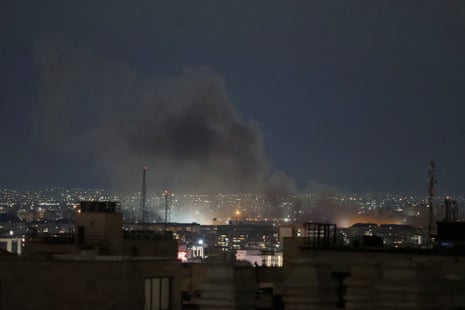
The IDF said this morning that it had completed “another wave†of airstrikes across the Iranian capital of Tehran.
Tehran was targeted with an intense wave of Israeli airstrikes yesterday that damaged residential neighbourhoods and reportedly struck a prestigious university.
US-Israeli airstrikes have repeatedly hit the densely populated city throughout the war.
Many civilians have been killed in the attacks, despite them framed as only targeting the infrastructure of the Iranian state and targets linked to the regime.
Iran's parliament speaker: the outsider seen by White House as possible partner

Patrick Wintour
Trying to appoint Mohammad Bagher Ghalibaf from Washington reveals either a misunderstanding of the Islamic Republic's multilayered political system or a determination to upend it: power in Iran historically lies with the supreme leader, and Mojtaba Khamenei has been selected to that role by the Assembly of Experts.
While it is true that Khamenei has not been seen since his election and is believed to be seriously injured, Iran insists he is the functioning decision-maker…
As speaker of parliament, Ghalibaf has broadly followed the mainstream, supporting the 2015 nuclear deal but then, when Trump pulled out, arguing that Iran's future lay in alliances with Russia and China. His critics claim that Ghalibaf supporters backed the attack on the Saudi embassy in Tehran in 2016 that led to the breaking off of diplomatic relations between the two countries.
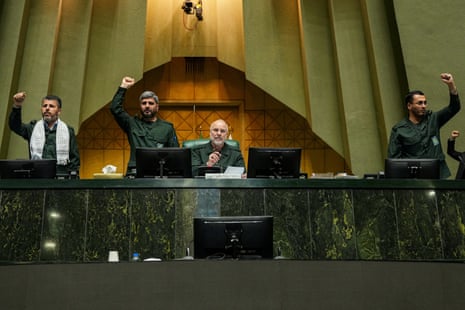
From Trump's perspective, little of this matters if he feels, in negotiating with Ghalibaf, he is negotiating with Iran's true power brokers. Ghalibaf does have lines to the commander-in-chief of the IRGC, Ahmad Vahidi, and the commander of the Khatam al-Anbiya central headquarters, Ali Abdollahi Aliabadi.
Soon after it became known that Washington thought he was reliable, Ghalibaf issued a tweet saying: “Our people demand the complete and humiliating punishment of the aggressors. All officials stand firmly behind their Leader and people until this goal is achieved. No negotiations with America have taken place. Fake news is intended to manipulate financial and oil markets and to escape the quagmire in which America and Israel are trapped.â€
Trump's anointment may at least send the message to Israel that Ghalibaf is not to be killed, but it also piles pressure on him to show he will not betray his country.
US secretly plotting ground attack despite message of diplomacy, Iran’s parliament speaker says
Iranian state media have published a message from Iranian parliament speaker Mohammad Bagher Ghalibaf marking 30 days since the start of the US-Israeli war.
“The enemy openly sends a message of negotiation and secretly plans a ground attack,†Ghalibaf, who has served as speaker of the parliament since 2020, wrote in his message carried by the Tasnim news agency.
“The United States expresses its desires with a list of 15 points and pursues what it did not achieve in the war.â€
“We are in a major world war, and we must prepare ourselves for the tortuous and difficult path ahead of us until we reach the summit,†he added.
Ghalibaf was previously an Islamic Revolutionary Guard Corps (IRGC) commander, police chief and mayor of Tehran. Washington reportedly has thought of him as a potential partner and he is reported to be Donald Trump's preferred choice for leader.
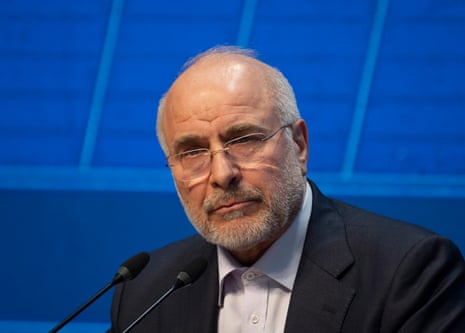
Photograph: Morteza Nikoubazl/NurPhoto/Getty Images
How likely is it that Donald Trump will order a ground invasion of Iran?

Andrew Roth
Thousands of US marines aboard navy amphibious ships from the 31st and 11th expeditionary units have been deployed to the Middle East from Asia.
Another 2,000-odd paratroopers from the 82nd Airborne are also being sent to the theatre – they are tasked with deploying worldwide within 18 hours of notification and execute parachute assaults, including against a “defended airfield†to prepare for further ground operations.
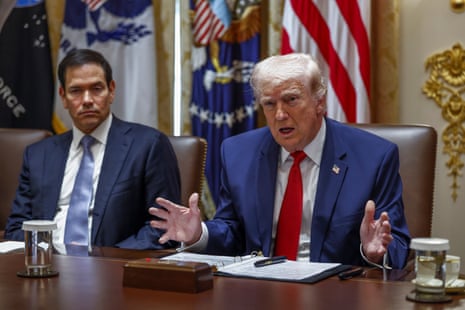
The secretary of state, Marco Rubio, repeated on Friday that the US believes it will be able to achieve its goals without boots on the ground, but when marines are in position next week, Trump could order an assault to either provide leverage to reopen the strait of Hormuz or to degrade Iran's ability to keep the waterway closed by force.
The lack of heavy armoured units, logistical depth and other elements needed for a protracted military conflict will limit the White House's ability to escalate the conflict, however, potentially extending a stalemate that could be devastating to the international economy. Read the full piece here:
Saudi Arabia's defence ministry said in a statement shared to social media about three hours ago that the country had intercepted and destroyed 10 drones in the previous few hours.
Qatari news channel Al Araby has said in a post on X that an Israeli missile had hit the building housing its office in the Iranian capital of Tehran, causing “extensive damage and halting live broadcastsâ€.