Charles McMahon was searching the backyard of a house in Hue City when a North Vietnamese Army soldier suddenly walked out of the bushes.
The man had his rifle still slung, his head down. He had not expected an American to be standing there. McMahon already had his M16 on fully automatic.
«He looked up, turned and ran, and I pulled the trigger,» McMahon said. «To this day I can see the look on his face … It was the first time a guy was right in front of me and I got him.»
A Marine watching from the road witnessed what had just happened. He said, «good shooting.»
It was Jan. 31, 1968. McMahon, a 19-year-old corporal from Cambridge, Massachusetts, had just fired some of the first shots of the Battle of Hue, the monthlong urban engagement that would become the bloodiest battle of the Vietnam War.
«It was definitely one of the first engagements,» McMahon said.
Nobody at Phu Bai had told McMahon the NVA held the city when his convoy rolled into the Hue suburbs. He and his Marines exited the area to rejoin their unit for the impending fight to retake Hue from the communists.
Meanwhile, Company A, 1st Battalion, 1st Marines, was moving toward Hue, fighting through fierce NVA ambushes to reach the city.
From Cambridge to the Marine Corps
McMahon was born in December 1948 in Cambridge, Massachusetts, and grew up in nearby Watertown. His grandfather had served with the Army’s 101st Infantry Regiment in World War I while his father was a Marine who fought on Guadalcanal.
«I didn’t know anyone who hadn’t fought,» McMahon said. «Most had been in World War II. My family were all veterans of some kind.»
His parochial school education reinforced his desire to serve as the nuns who taught him tracked the Cold War as a moral emergency. McMahon sat through nuclear bomb drills and listened as his teachers prepared him for life. One of the nuns told him it was better to enlist than be drafted and if you could get into an elite unit, you owed it to yourself to try.
When he told his father he was joining the Marine Corps, the Guadalcanal veteran warned him he could get hurt.
«But he was proud,» McMahon said.
McMahon signed a two-year enlistment in August 1966 at 17, too young to deploy. He figured Vietnam would be over before he even finished training. His father offered one last practical note, go to Parris Island in the fall to avoid the summer heat.
Semper Fi
McMahon arrived at Parris Island as the smallest recruit in his platoon, which earned him the job of «house mouse» or errand runner for the drill instructors.
Upon graduating, McMahon, like many other Marines at the time, was assigned the job of infantryman. From Parris Island he went to infantry training at Camp Geiger, then to Delta Company, 1st Battalion, 6th Marines at Camp Lejeune.Â
His fireteam leader, squad leader and company commander were all Vietnam veterans. These men, some barely older than McMahon, occasionally stopped field exercises to walk the newer Marines through what they had survived.
«Anytime we went to the field, they would say, ‘Hey, never do that in Vietnam,'» McMahon recalled them saying. «‘The NVA would likely come up this draw. This is where you put your gun.'»
One afternoon in the communal showers, McMahon noticed a healed bullet wound in a fellow Marine’s chest. The man’s flak jacket had stopped the round from going all the way through.
«That’s when I realized this is serious,» McMahon said. «You could see they were serious as a heart attack. Maybe 19, but they talked like they were 30.»
His NCOs briefed the platoon plainly on what was waiting for them in Vietnam. VC fighters who would ambush them, shoot quick then run, as well as Main Force units capable of battalion-size operations. Then there were the NVA regulars who were professional soldiers with modern weapons and equipment.
Arriving in Vietnam
McMahon arrived in Vietnam in November 1967. Upon entering the processing station, a clerk informed him there were some openings in Force Recon if he was interested.
«I bet you do have openings,» McMahon said. «If you’re out there with them and the enemy get you, then they get the whole team. I decided no.»
McMahon instead reported to Hotel Company, 2nd Battalion, 5th Marines at An Hoa Combat Base, about 28 miles south of Da Nang.
The veterans worked newer Marines gradually into the pace of patrols, road sweeps, and listening posts. McMahon’s first firefight came on a patrol when an enemy suddenly fired at him. He instinctively jumped behind cover. His platoon sergeant walked calmly down the road as the enemy continued firing.
«Get up and shoot at that asshole,» McMahon recalled his platoon sergeant saying. «Anytime someone shoots at you, you get up and shoot back immediately.»
By the time McMahon got up and returned fire, the enemy was gone. For the first time, he realized the enemy was actively shooting at him. It was personal.
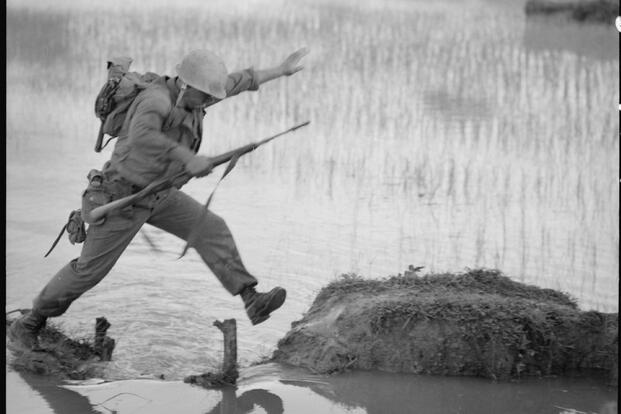
Lt. Kenneth Kromer, McMahon’s platoon commander, eventually asked him to come along as a bodyguard while he checked tunnels inside the perimeter on Operation Auburn.
At one point during the operation, McMahon and his squad found a group of missing Marines. The men had been wounded, stripped of their weapons and executed. Their corpsman appeared to have been targeted first. McMahon helped carry one of the dead toward a landing zone.
«When you normally touch a person, they’re warm,» he said. «But he was ice cold. I knew he was dead. But when you touch him and it’s cold, it really hits you.»
One of the dead had an unsigned Pfc. promotion warrant tucked in his utility jacket.
«I remember thinking, ‘Jeez, a new guy,'» McMahon said. «I was angry. I wanted payback.»
The Impending Assault
In late December 1967, Hotel Company flew north to Phu Bai and began operating along Highway 1 as American commanders rushed forces north in anticipation of a major NVA offensive. McMahon’s patrol found a tree line with nearly 100 freshly dug fighting holes, each camouflaged with brush and cover stacked in front.
«A hundred holes, maybe 200 men,» McMahon said.
The Marines realized a sizeable enemy force was nearby. Unlike the VC, the NVA would stand and fight if they thought they had a chance.
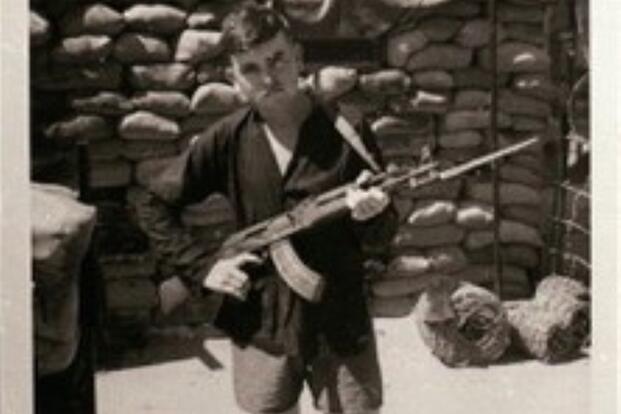
One of the company’s squads, led by McMahon’s friend Bob Meadows, soon ambushed a group of NVA soldiers and brought back brand-new Chinese AK-47s.
Meadows teased McMahon about him not getting into contact with the NVA yet, saying, «Hey, when are you gonna get some?»
McMahon would not have to wait long. Capt. George R. Christmas, Hotel Company’s commanding officer and later a lieutenant general, laid out the intelligence assessment for his men.
«He said intel told him it was a coiled spring out there, just waiting to get released against us,» McMahon recalled.
In those same weeks, McMahon drew convoy security detail, riding supply runs along Highway 1. He passed through Hue twice. It was a French-built city with tree-lined boulevards, a major university and a hospital. The Marines would routinely stop and buy coffee and baguettes from the locals.
«We didn’t know it at the time,» McMahon said. «But Tet was about to break out.»
The Battle of Hue Begins
On Jan. 31, 1968, McMahon’s squad drew security for a convoy hauling 10,000 artillery rounds toward the outskirts of Hue. Rolling north out of Phu Bai, he spotted two figures standing on the side of Highway 1 including a small blonde woman with pigtails and a man in civilian clothing. He stopped.
The woman introduced herself as Catherine Leroy, a French combat photographer who had been covering Vietnam since 1966, been seriously wounded once and even parachuted into combat with the 173rd Airborne. She had received a tip at the bureau in Saigon and was heading toward Hue. McMahon told her to get in.
As the convoy rolled, Leroy asked what he had been briefed about conditions ahead.
«Maybe a platoon up there, some snipers,» McMahon said.
«No, no. It’s much worse. The NVA hold the city,» Leroy said.
McMahon figured his command would have told him about that if it was true.
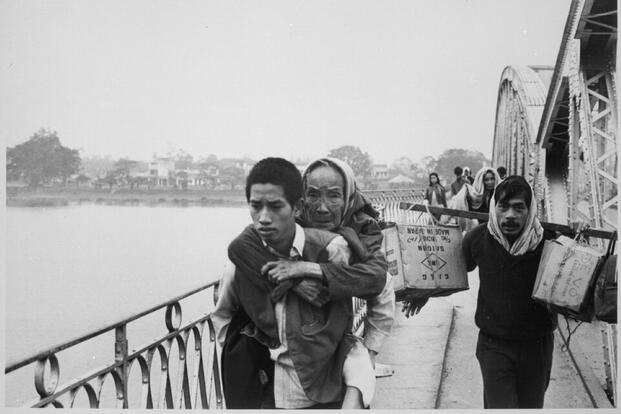
As they neared the city, the highway became empty. No civilians on the road. Suddenly, an A-1 Skyraider banked north through columns of smoke. The Marines realized something was wrong.
The convoy was stopped by barricades at the An Cua bridge. Leroy got out, raised her hands and walked across into Hue. She was captured by NVA forces soon after and spent several days as their prisoner. She talked her captors into letting her photograph them behind their own lines, and the images ran on the cover of Life magazine’s Feb. 16, 1968, issue.
The convoy turned away from the bridge. They hit an improvised roadblock almost immediately made of bamboo and furniture sprawled across the road. McMahon fanned his squad into the backyards behind the single-story concrete homes along the road to secure the area. Tet decorations still hung in the windows with red flowers, but nobody was around.
As McMahon entered a house, an NVA pith helmet sat on the kitchen table. When the homeowner appeared from another room, McMahon questioned the man who claimed it was his son’s. McMahon sent the man outside to fill canteens for the Marines.
McMahon then stepped into the backyard when the NVA soldier came out of the bushes.
Payback
After McMahon shot the soldier, a young Vietnamese man came out of the house next door and motioned. He told the Marines that eight NVA soldiers were inside.
The Marines ordered the man to get any civilians out of the building. After the civilians fled, the Marines launched M79 grenade rounds through the windows. The Marines then stormed the house and cleared it room to room. All eight enemy troops were killed.
«I kind of regret it in a way,» McMahon said. «But it was my job to kill them.»
McMahon and his Marines had finally avenged the dead Marines they had found weeks earlier.
The NVA then began hitting the convoy in force. Organized fireteam rushes, one element laying down fire while another bounded forward. McMahon had never seen the enemy operate that way in the open.
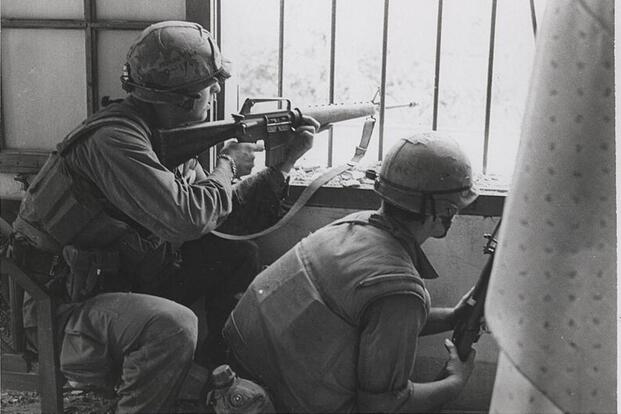
Mortars began falling around them. McMahon positioned his machine gun in a nearby cemetery and his squad held against a fierce enemy assault. At one point, an enemy soldier climbed over cover with his arms raised, though he was holding what appeared to be a grenade in his hand.
The Marines screamed at him to drop it while they readied their weapons on him. Upon approaching him, the Marines realized he had been wounded in the hand and was holding bandages to stop the bleeding. They took him prisoner.
Some of the convoy’s drivers had been hit in the attack. A few of the rural Marines in the group who were raised in places like West Virginia climbed into the trucks to drive them out.
One Marine went into a treeline after a group of NVA soldiers and never came back. His remains were recovered months later.
«The only reason they didn’t wipe out the convoy,» McMahon said, «was that they were moving into the city and we kind of brushed into them.»
The Marines fell back to the trucks, loaded up their prisoner and began moving out of the area. Most of the Marines were wounded and one man was missing.
The Graveyard Convoy
Word soon came down that another convoy had been ambushed on the road north of Hue. McMahon’s squad formed up with Lt. Stewart Brown from Echo Company, who laid out what they were going into. Two Army quad .50 vehicles would lead. The lead vehicle was to stop at the ambush site and put down a base of fire.
The driver didn’t stop. He drove the length of the kill zone at full speed with the quad .50 going the whole way and came out the other side. The Army lieutenant in the cab was dead before the truck cleared the ambush.
McMahon and the Marines fanned into the graveyard alongside the road as the remaining quad .50s laid down suppression. When they reached the stalled convoy, the two Ontos vehicles were sitting there undamaged. The crews were dead. The 106mm tubes were empty. Some order had come down prohibiting the vehicles from traveling with rounds loaded, which meant the crews had to get out to reload. They never made it back inside.
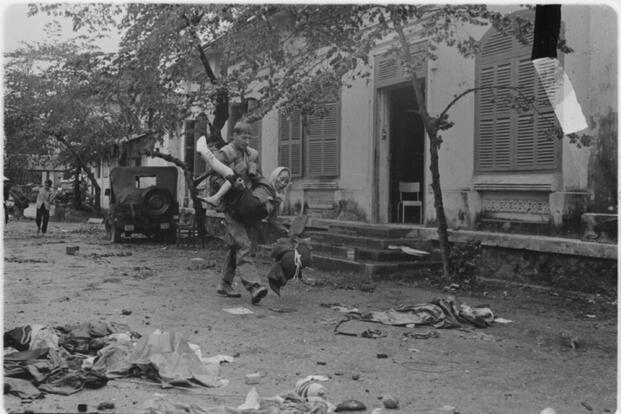
Corpsman Leroy Morin climbed up onto one of the Ontos and checked to see if the Marine on the front of the vehicle was alive.
McMahon and the others started pulling bodies out. Two corpsmen moved through the trucks checking the wounded. Lt. Brown was on McMahon the whole time, pushing him to move faster. It was still daylight when they reached the site. It was near midnight by the time they had worked through every vehicle.
Morin told Lt. Brown they had to leave now. The wounded would bleed out before morning if they stayed.
The convoy drove back in the dark, firing into the tree lines on both sides as they went. They stopped a few times to tighten tourniquets, taking some fire but they made it to Phu Bai.
Twenty Marines had been killed in the ambush.
‘Like Dante’s Inferno’
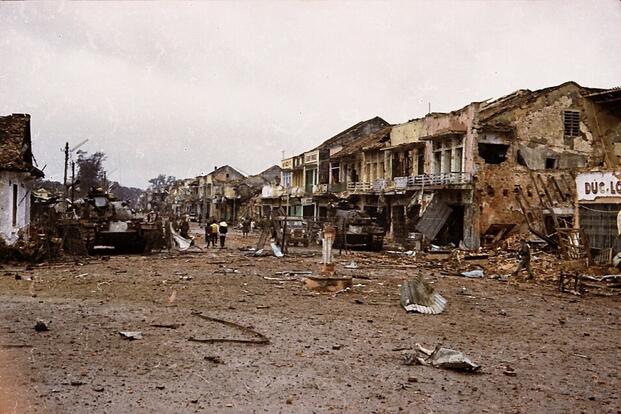
McMahon rejoined Hotel Company outside Hue as Lt. Kromer returned from R&R in Australia. Nothing about the city he entered resembled anything he had even seen before.
«When I fought in the suburbs and then entered the city, it was a shock,» he said. «Like Dante’s Inferno. Everything was on fire. Dead NVA littered the street. Rubble everywhere.»
As Company G, 2nd Battalion, 5th Marines attempted to cross the bridge into the city on the first day, they were pinned down by heavy enemy fire. Five Marines were killed, 44 were wounded. Nearly a third of the force had become a casualty on the first day alone.
The battalion was under the command of Lt. Col. Ernie Cheatham, later a brigadier general, who gave his Marines the lead role in clearing the southern half of the city. U.S. Marines had not fought in a major urban environment since Seoul in 1950, and there was no current doctrine for it. Cheatham dug up an old Korean War-era manual on urban tactics and began putting it to use.
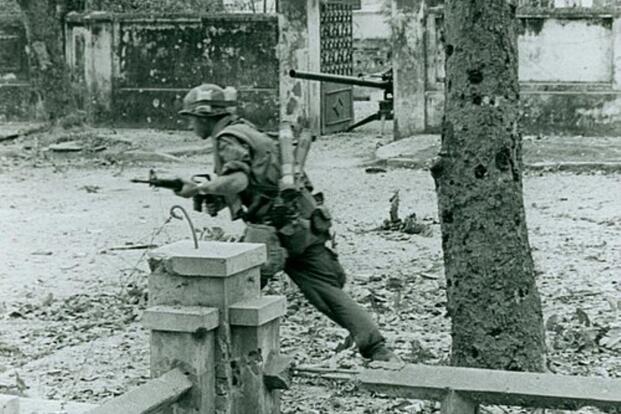
Marine doctrine called for entering buildings through windows to avoid the fatal funnel of a doorway. In Hue, every first-floor window was barred with iron. Marines went through the doors and paid for it until the engineers solved the problem. Ten pounds of C-4 packed against a compound wall blew a hole where the NVA weren’t aiming.
Block by block, nothing about it got easier. McMahon would kick a door, clear each room, then move to the next house and start over. One afternoon he kicked a door and it swung open onto a family huddled in the middle of the floor. A mother, a father and their children. The father looked up at the armed Marine in his doorway and made the sign of the cross.
McMahon told him they were Americans. The children jumped up and started brushing plaster dust off his uniform.
«They had big smiles on their faces,» McMahon said. «The NVA were taking people and killing them. These people were just glad to see us.»
Block by Block
Not every room held a family. One afternoon an NVA soldier spotted McMahon through a window and fired a B40 rocket. The round caught the window frame. There was a bright orange flash. When McMahon got up off the floor, piles of American money littered the floor, blown down from somewhere in the rafters by the concussion.
Down by the Phu Cam Canal, near the power plant, Hotel Company dug in and held the line. The plant was still running, operated by a Frenchman nobody could explain. He dressed like a film character in a leather jacket and a fedora, and twice he walked over to McMahon’s position carrying a bottle of cognac, which the Marines passed from man to man.
The NVA never touched him. McMahon figured they wanted the lights to stay on.
The streets remained the central tactical problem. Throwing smoke to screen a crossing told the NVA exactly where to aim. Hotel Company worked out a solution by throwing smoke with no intention of moving. The NVA always fired into the smoke. When they did, the M50 Ontos had a target.
The Ontos carried six 106mm recoilless rifles. Cheatham used it like a battering ram, personally walking forward under fire to ground-guide it into position when an NVA strongpoint stalled the advance. McMahon watched him do it more than once.
«He would just say, ‘Level it,'» McMahon said.
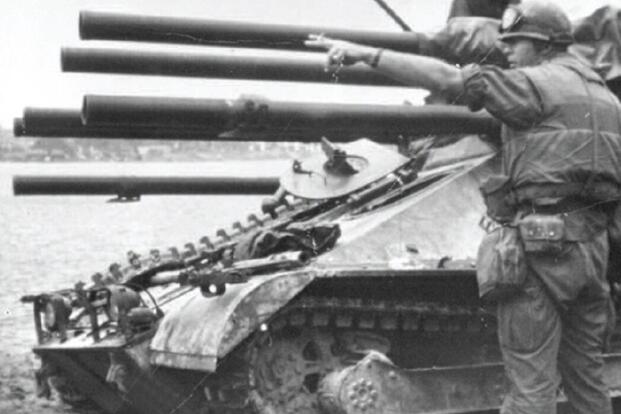
One Marine got the idea of using the back blast of a 106mm recoilless rifle mounted on a mechanical mule as cover to cross the street. Capt. Christmas endorsed the tactic immediately.
Along the waterfront, a Marine officer found a cache of E8 CS gas launchers. The NVA had no gas masks and their doctrine required withdrawal when gas was deployed, allowing the Marines to storm the building. McMahon found several dead NVA soldiers afterward with improvised masks fashioned from banana husks and bandanas.
«If we used gas, they retreated,» McMahon said.
One afternoon McMahon and a Marine named Morales were clearing a house near the power plant when an NVA soldier ran past a window and threw a grenade through the bars.
«Morales grabbed me by the flak jacket and pulled me around the corner,» McMahon said.
The grenade detonated where he had been standing.
In the midst of the hellish fighting, McMahon again encountered Leroy. He and the other Marines were covered in plaster dust from the constant engagements and explosions in the residential areas. As he washed his face off, she came over to him.
«I’ve seen you before,» Leroy said. «You look a lot younger with a clean face.»
On Feb. 5, with two of Hotel Company’s platoons stalled under heavy fire from a fortified building complex, Capt. Christmas stood on top of a tank to direct its main gun. B40 rockets hit around him until the NVA position was destroyed. Christmas was later awarded the Navy Cross.
The following day, Feb. 6, Hotel Company seized the Thua Thien Province headquarters building, which the NVA’s 4th Regiment had used as its command post.
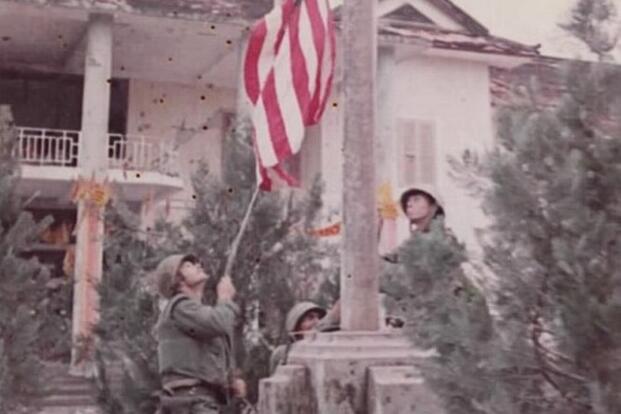
Three Marines, including Walter Kaczmarek, pulled down the Viet Cong flag and raised the Stars and Stripes. American regulations prohibited it. The United States was fighting in support of South Vietnamese sovereignty and only the South Vietnamese flag was authorized over liberated territory. Cheatham knew the rule, so he sent a brief message to Phu Bai.
«Be advised we have taken Provincial Headquarters,» he reported. «Somehow or other, an American flag is flying over there.»
‘No One’s Pushing Us Around’
By Feb. 11, the officers were falling faster than they could be replaced.
Lt. Leo Myers grabbed a sack of grenades, sprinted alone down an alley, and threw them over a compound wall at NVA soldiers who had his Marines pinned from above. A mortar round injured him on the way back.Â
Lt. Kromer was also evacuated after being wounded. Lt. Mike Lambert of 3rd platoon was then hit. Christmas was wounded and eventually transferred to Philadelphia Naval Hospital. McMahon’s best friend, Meadows, was wounded that day as well.
On a single day, Feb. 13, Hotel Company suffered 28 wounded.
«No one was killed that day,» McMahon said. «We were blessed.»
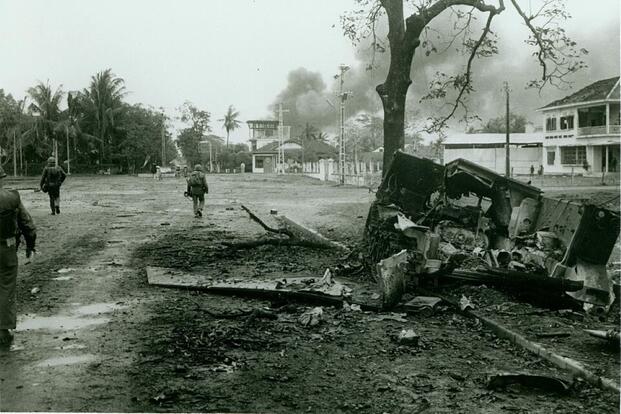
Staff Sgt. Johnny Miller took command of what remained and gathered the men at the Jesuit Boys School near the front line.
«Listen, we’re going back, and no one’s pushing us around. I know we had a tough day, but we’re going back slow. Keep your heads up,» McMahon recalled him saying.
McMahon noted that Hotel Company by that point was barely the size of a single platoon.
Miller ran what remained of the platoon the same way they had been fighting since the first week, slow and deliberate, using everything they had learned about urban combat. First Battalion, 5th Marines came through their lines to assault the Citadel from the south.
By late February the NVA had faded from the south side of the city and civilians began streaming back through the streets. McMahon knew the battle was over as he saw Army paratroopers from the 101st Airborne after they helped mop up enemy forces outside the city. McMahon noted that despite the sibling rivalry between the branches, the Marines and paratroopers were happy to see one another.
The NVA flag came down from the Citadel on Feb. 24. Hotel Company had done its job.
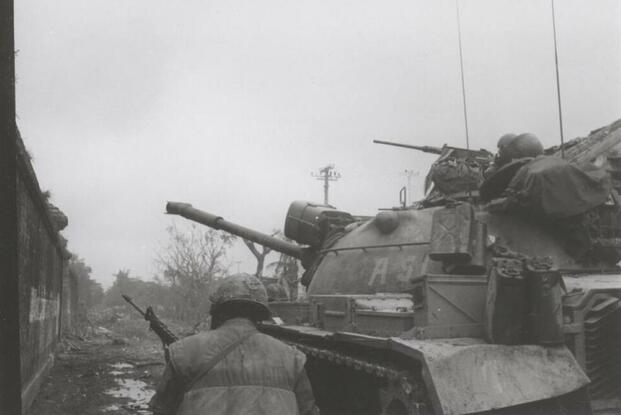
McMahon noted his platoon lost only around seven men killed in the battle. It could have been far worse. Golf Company, 2/5, had been hit hard while crossing the Nguyen Hoang Bridge. The other units suffered heavy losses while taking their objectives.
Hotel Company fought through backyards and blown up walls with the Ontos and Patton tanks clearing the way. The route of attack made the difference.
«I don’t know anybody who wasn’t hurt or wounded,» McMahon said.
About 150 Marines were killed in Hue, over 800 were wounded by the battle’s end. Hundreds of ARVN troops and nearly 1,000 civilians also died. The NVA suffered as many as 5,000 casualties in Hue City.
‘I Live Here’
McMahon spent his final months with a Combined Action Program counterinsurgency unit south of Phu Bai. One Marine squad, a corpsman and South Vietnamese Popular Forces soldiers lived together inside a village. The team conducted night ambushes while training the locals to defend their own homes.
«It was hours and hours of boredom, interrupted by moments of stark terror,» McMahon said.
At one point, a grenade went off close enough to put shrapnel in McMahon’s leg, but his platoon commander told him to stay put and keep working with the new guys since he could still walk.
One night during an ambush, some of the local fighters stopped firing and retreated. McMahon confronted a Vietnamese sergeant, demanding to know why they didn’t fight harder. This was their home after all.
The sergeant looked at him and said, «At the end of your tour, you go home. I live here. I have to do this until it is over.»
«The way they saw it, I only have a year here,» McMahon said. «For them, you can’t be brave all day, every day.»
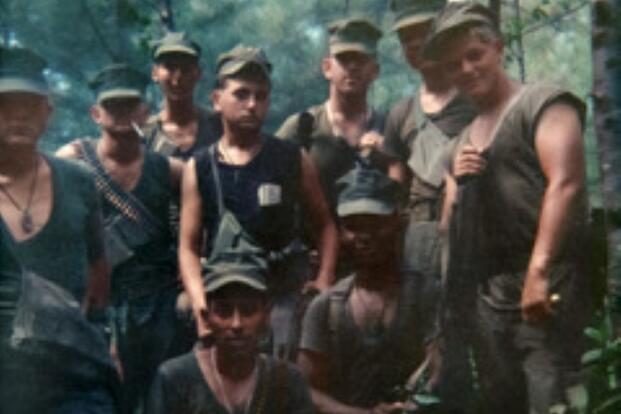
Not all local fighters were quick to run away. On one operation a Kit Carson Scout, a former VC fighter working alongside the Marines, suddenly went tense and started scanning the brush. He pointed out a bunker McMahon had walked right past. McMahon threw a grenade in. Upon inspection, there were two AKs inside and a dead VC. The scout quickly went in after the surviving enemy while screaming.
In the summer of 1968, on a routine patrol, a mortar barrage caught the unit in the open. McMahon remembers a flash. Then nothing. He woke in a hospital in Da Nang with a tracheotomy tube in his throat, shrapnel wounds in both legs and IVs in each arm.
The doctor came over and asked how much time he had left in the Corps.
«A month,» McMahon said.
The doctor responded, «When you can walk to that door, you can go home.»
He was medically evacuated to Chelsea Naval Hospital outside Boston. His family was able to visit him while he recovered.
Upon seeing him, his grandmother said, «You know, for being in the tropics, you don’t have much of a tan.»
McMahon was discharged as a corporal in August 1968.
Returning to Vietnam
McMahon later returned to Vietnam twice. In 1994 he walked the old battle sites alongside Lambert with a joint task force under Lt. Gen. Christmas, then overseeing MIA recovery efforts.
While walking a street near the old MACV compound in Hue, McMahon came around a corner and was stopped cold. An NVA soldier in full uniform, pith helmet included, was jogging through an adjacent yard with an AK-47 on his shoulder, moving fast, head down.
McMahon was frozen. For a second, he was back on the outskirts of Hue watching a soldier come out of the bushes.
One of the American Special Forces soldiers from the Joint Task Force on Full Accounting on the tour stepped over to McMahon. It was just a military guard late for his post, he said.
McMahon relaxed as he watched the soldier jog out of sight.
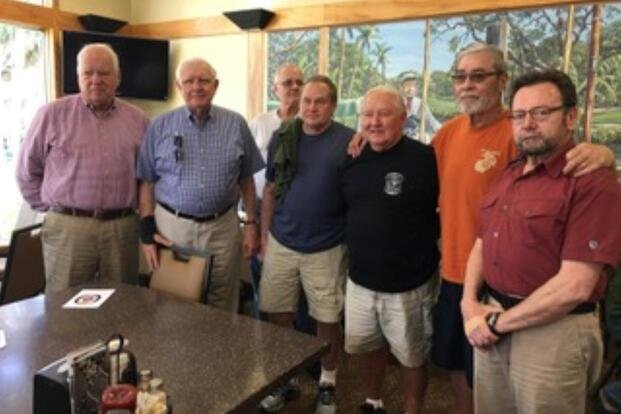
On a quiet stretch between sites, McMahon noticed a Vietnamese soldier asleep at his post, rifle across his lap, completely out. In a previous time, McMahon would have been horrified at the sight. If he was the man’s commander, he would have been furious. Instead, he just looked at the soldier.
The guard looked up at the American, nodded, then rolled over and went back to sleep. McMahon had a sudden realization.
«These people had moved on and were now at peace,» he said. «In my head, it was finally over.»
Through an interpreter McMahon spoke with several former enemy soldiers during the trip. Many were distant at first, but extremely friendly and welcoming to the American veterans once they were able to converse. Vietnamese people, as McMahon noted, did not dwell on the past. They looked toward the future.
Then, an NVA veteran asked him to carry a message back to the United States.
«Tell your friends they are welcome here,» the man said.
His Life After the Marine Corps
McMahon used the GI Bill for aviation school at East Coast Aero Tech and Embry-Riddle Aeronautical University, but pilot jobs were scarce. He went to the railroad instead, working for Conrail and Amtrak for 38 years before retiring as senior director of engineering.
Conrail even sent him to the University of Pennsylvania for an MBA. He married his wife Susan in 1969 and raised two daughters and a son. He lives now in Ponte Vedra Beach, Florida.
In the 1980s, McMahon was able to speak with Leroy again for the first time since the Battle of Hue. The photographer had survived the battle and was working in Hong Kong. They talked about the ride into Hue, the battle, the years since. He even has a photograph of her with one of his Marines.
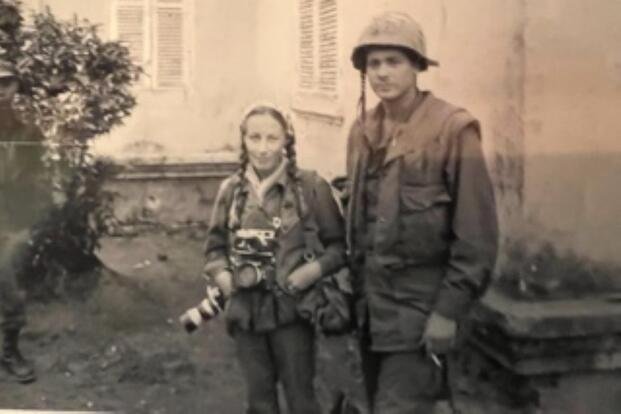
Today, McMahon is proud of his service in the Marine Corps and the men he served and sacrificed alongside. He is still friends with Brown, Kromer, Morin, Meadows and many of the other Marines who cleared the city.
He also thinks about the thousands of civilians the NVA executed in Hue before 2/5 arrived, the mass graves that were still being discovered years afterward and what Hotel Company stopped by pushing through the city.
«We fought outnumbered,» McMahon said. «We killed half the attacking force without leveling the city with B-52s. It was a great victory and worthy cause … we fought the good fight.»
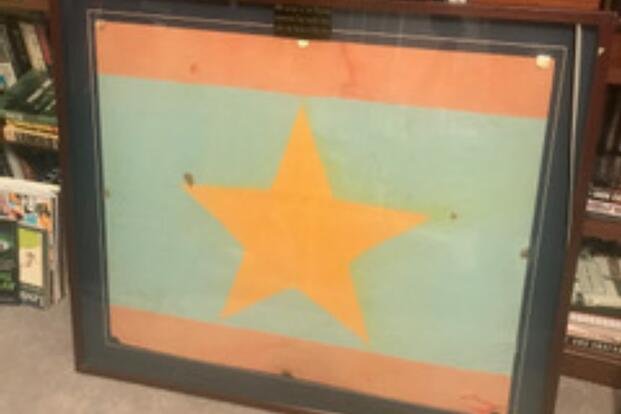
For years, the officers and crew of the USS Hue City welcomed McMahon and other veterans of the battle aboard to honor their service. Most Navy ships were named after long ago events and figures that had already passed. The sailors on the ship were always excited to meet the fighting men who inspired their vessel’s name.
The VC flag the Marines pulled down in Hue was kept aboard the guided-missile cruiser until the ship was decommissioned. It was then given to Don Swanger, a Marine who crewed one of the Ontos vehicles that fought through Hue.
One year, a young sailor asked McMahon what the battle had been like. McMahon described the fighting in detail. The sailor listened, then asked a follow-up question.
«What did the Marines do on their days off?» the sailor asked.
«I said there were none,» McMahon recalled.
«That sucks,» the sailor responded.
«I know,» McMahon said.